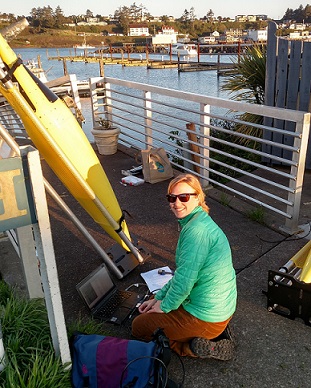
About Me
I am an Assistant Professor, Senior Research at the Marine Mammal Institute and the Department of Fisheries, Wildlife, and Conservation Sciences at Oregon State University. I also am an affiliate collaborator with the Protected Species Division at NOAA NMFS Pacific Islands Fisheries Science Center where I am part of the Uncrewed Marine Systems Program. I enjoy using novel acoustic technologies to answer applied questions in conservation, management, and ecology. I am particularly interested in using autonomous platforms, such as gliders, as survey tools for passive acoustic monitoring of marine mammals.
I am part of a collaborative team from Oregon State University, PIFSC, and the Southwest Fisheries Science Center (SWFSC), that is developing a Pacific-wide uncrewed systems program for glider-based passive acoustic monitoring of the US West Coast and Pacific Islands. We are working to advance the use of acoustically-equipped underwater gliders to augment exisiting ship-based cetacean surveys through direct platform and sensor comparison studies, concurrent ship- and glider-based surveys, and development of advanced statistical models to incorporate single-hydrophone glider data into species distribution and density models. More about this work can be found at our NMFS PAM Glider site. Through this work I continue to develop agate (Acoustic Glider Analysis Tools and Environment), a MATLAB-based toolbox for working with passive acoustic Seagliders. More info on agate can be found at sfregosi.github.io/agate
I am also an Associate Scientist at Southall Environmental Associates (SEA) where I help with various field and analysis efforts looking at the behavioral responses of different cetaceans to exposure to navy sonar.
My dissertation research (with the Cooperative Institute for Marine Resources Studies at Oregon State University) focused on comparing gliders and autonomous deep-water floats to traditional stationary underwater recorders for acoustic monitoring of cetaceans and developing acoustic density estimation methods for these dynamic recording platforms.
Education
- Ph.D. in Wildlife Science, Oregon State University
- M.Sc. in Wildlife Science, Oregon State University
- B.A. in Marine Science, University of San Diego